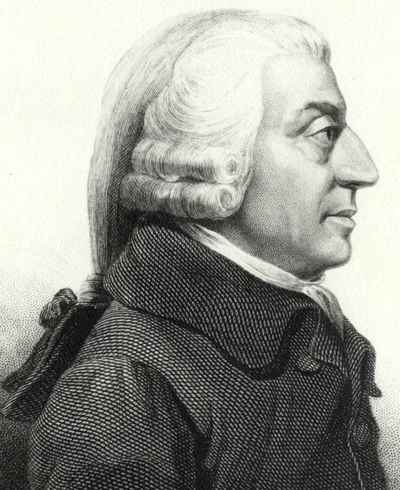
Adam Smith portrait by unknown artist, Muir profile - public domain
Adam Smith
The Father of Modern Economics
It is not from the benevolence of the butcher, the brewer, or the baker that we expect our dinner, but from their regard to their own interest.
Why speak with Adam
Talk to Adam Smith to explore the foundations of capitalism and free markets, discuss the division of labor and productivity, understand the role of the "invisible hand," and learn about his moral philosophy based on sympathy.
Areas of expertise
- Division of labor
- Free market theory
- Moral philosophy
- Political economy
- Sympathy and ethics
Brief biography
Scottish philosopher and pioneer of political economy, author of The Wealth of Nations, who formulated the concepts of the division of labor and the "invisible hand."
Achievements
- 01Authored The Wealth of Nations (1776), establishing the field of modern economics
- 02Developed the concept of the "division of labor," demonstrating how specialization increases productivity
- 03Formulated the metaphor of the "invisible hand" to explain self-regulating market forces
- 04Authored The Theory of Moral Sentiments (1759), explaining ethics through human sympathy and the "impartial spectator"
- 05Pioneered the critique of mercantilism, advocating for free trade and consumer welfare
Notable works
The Wealth of Nations
His economic masterpiece, analyzing the source of national prosperity, division of labor, markets, and the role of the state.
The Theory of Moral Sentiments
His foundational ethical work, explaining moral behavior through the concepts of sympathy and the impartial spectator.
Ready to begin?
Ask Adam anything. Every reply is grounded in their own writings (this is an AI simulation, not the real Adam Smith).