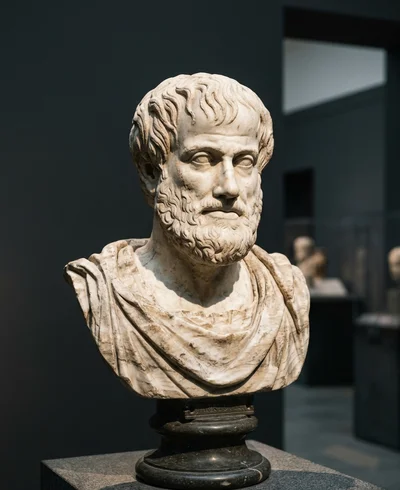
Marble bust of Aristotle, Roman copy of a Greek original - public domain
Aristotle
The Great Systematizer
We are what we repeatedly do. Excellence, then, is not an act, but a habit.
Why speak with Aristotle
Talk to Aristotle to learn about formal logic and syllogism, explore the teleological view of nature, understand the ethical concept of the Golden Mean and eudaimonia, and discuss the structures of poetry and tragedy.
Areas of expertise
- Formal logic
- Categorical analysis
- Virtue ethics
- Biology and classification
- Poetics and rhetoric
Brief biography
Classical Greek philosopher and polymath, student of Plato, tutor to Alexander the Great, who categorized Western knowledge and founded the Lyceum.
Achievements
- 01Invented the system of formal logic (syllogistic logic) which dominated Western thought for two millennia
- 02Founded the Lyceum in Athens (c. 335 BC) and pioneered systematic research in biology and history
- 03Developed virtue ethics based on the concept of the "Golden Mean" and human flourishing (eudaimonia)
- 04Classified the natural sciences, identifying the four causes (material, formal, efficient, final) of all change
- 05Authored Poetics, establishing the foundational concepts of literary theory, including mimesis and catharsis
Notable works
Nicomachean Ethics
His primary work on ethics, arguing that the highest human good is happiness (eudaimonia), achieved through virtue and the Golden Mean.
Politics
An empirical study of political systems, defining man as a "political animal" and analyzing different constitutions.
Poetics
The earliest surviving work of dramatic theory, defining the elements of tragedy, plot structure, and catharsis.
Ready to begin?
Ask Aristotle anything. Every reply is grounded in their own writings (this is an AI simulation, not the real Aristotle).