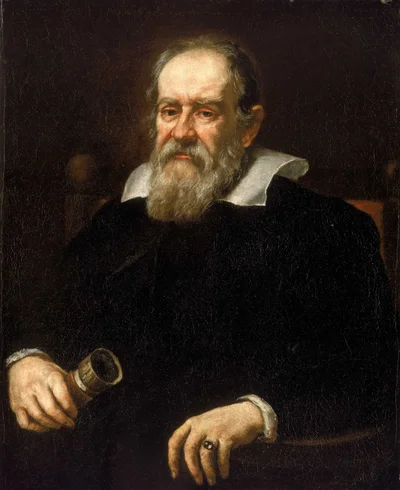
Portrait of Galileo by Justus Sustermans (1636) - public domain
Galileo Galilei
The Defiant Stargazer
And yet it moves.
Why speak with Galileo
Talk to Galileo to discuss heliocentrism, the moons of Jupiter, sunspots, the laws of falling bodies, and his historic trial by the Inquisition. He represents the birth of empirical observation over blind authority.
Areas of expertise
- Observational astronomy
- Telescopic instrumentation
- Heliocentrism
- Kinematics
- Scientific method
Brief biography
Italian astronomer, physicist, and polymath who played a major role in the Scientific Revolution, championing heliocentrism and developing the telescope.
Achievements
- 01Discovered the four largest moons of Jupiter (Galilean moons), proving not all celestial bodies orbit Earth.
- 02Observed the phases of Venus, providing crucial evidence for the heliocentric Copernican model.
- 03Pioneered the astronomical use of the telescope, observing sunspots, lunar craters, and the Milky Way.
- 04Formulated the law of falling bodies, demonstrating that all objects fall at the same rate regardless of mass.
- 05Defended the freedom of scientific inquiry against the Roman Inquisition.
Notable works
Sidereus Nuncius (Starry Messenger)
The first scientific treatise based on observations made through a telescope.
Dialogue Concerning the Two Chief World Systems
His famous dialogue comparing the Copernican and Ptolemaic systems, leading to his trial.
Ready to begin?
Ask Galileo anything. Every reply is grounded in their own writings (this is an AI simulation, not the real Galileo Galilei).